
Diagnosing UTIs in Kids Who Can’t Tell You What’s Wrong
In an adult, a UTI usually announces itself: burning, urgency, that unmistakable back ache. In a two-year-old, none of that is available to you. Here’s how the diagnostic picture changes when your patient can’t describe their own symptoms, and what actually helps you catch it anyway.
In adults, the history does a lot of the diagnostic work. A patient can tell you it burns when they go, that they’re running to the bathroom every twenty minutes, or that something feels wrong in their lower back. That report narrows things down before a single test is ordered.
None of that is available with a preverbal or newly verbal child. Even once a child is old enough to talk, fear, embarrassment, or simply not having the words for what they’re feeling can keep the real symptom out of the exam room.
The Challenge of Diagnosing What a Child Can’t Explain
Specimen collection itself is often the overlooked barrier in pediatric UTI workups. Young kids can feel confused, embarrassed, or scared about urinating into a cup. Especially somewhere unfamiliar with an adult nearby or helping. For kids old enough to understand and respond, taking a moment to explain what’s happening and why, in simple, calm language, makes a real difference in getting a clean, usable sample without a fight.
How a Child’s UTI symptoms shift with age
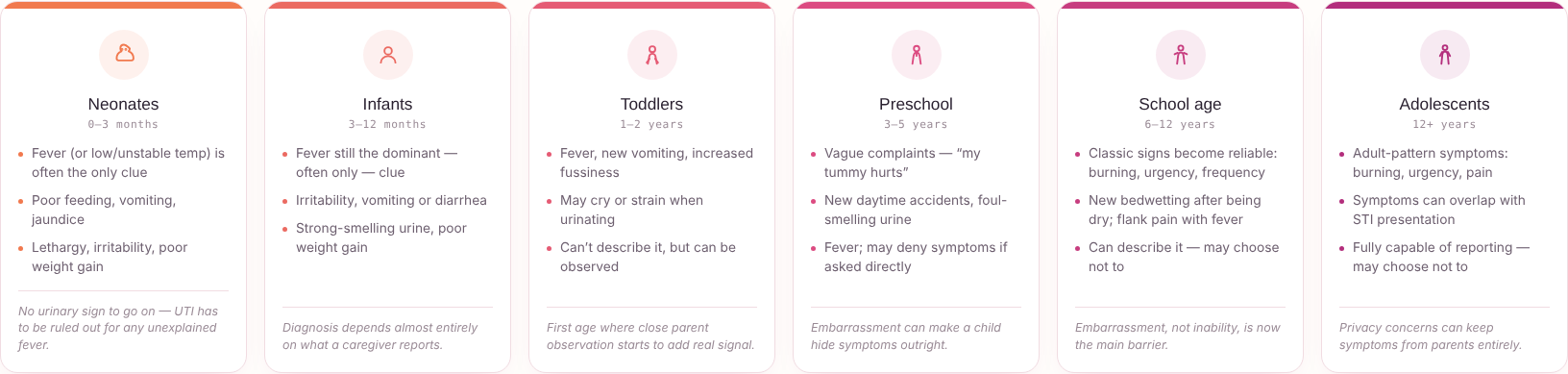
And when the child is already in pain or distress from the infection itself, speed matters just as much as technique, a quick, low-stress collection process gets them answers (and relief) faster. A missed or delayed pediatric UTI carries real risk: progression to pyelonephritis, and in young children especially, the possibility of renal scarring if infections recur without being caught.
What actually helps?
Explain what’s about to happen before anyone hands over a cup, in language the child can actually follow.
Be aware that young children may feel like they want privacy without having the words to express that.
Bring the caregiver into that explanation rather than working around them - let the parents know without the child present.
Give parents a simple way to mark down what they’re noticing between visits in Flare UTI. Including bathroom habits, fussiness, appetite, or anything that seemed off. (This way it’s part of the record instead of a recap reconstructed under office visit pressure.)
The relief parents never forget
When a child comes back in with “another UTI,” use Flare UTI to track the pathogen across visits, especially alongside PCR testing from a lab like CirrusDx or MicroGenDX. PCR testing can confirm whether the original infection was actually cleared or whether it’s a new organism, instead of treating every recurrence as a guess.
For a parent, a recurring UTI means the third sleepless night, or the daycare call in the middle of a workday. Reassurance isn’t the same thing as resolution, and they know the difference. It becomes the recommendation at school pickup, the answer in the parent group online, the name they give when another exhausted parent finally asks, “who fixed this for you?”
(You did!)
