
Why (and When) to Consider PCR Testing for Recurrent and Complicated UTIs
For a lot of patients with real, painful urinary symptoms, a trip to urgent care ends the same frustrating way: a quick in-office test comes back negative, and they're sent home without a diagnosis or a treatment plan. It's a common and genuinely distressing experience. The pain is real, but the test used to confirm it often isn't sensitive enough to catch what's actually happening.
Understanding why that gap exists, and where PCR testing fits into closing it, matters for every physician whose patients keep coming back still in pain.
Why Walk-In Testing Falls Short
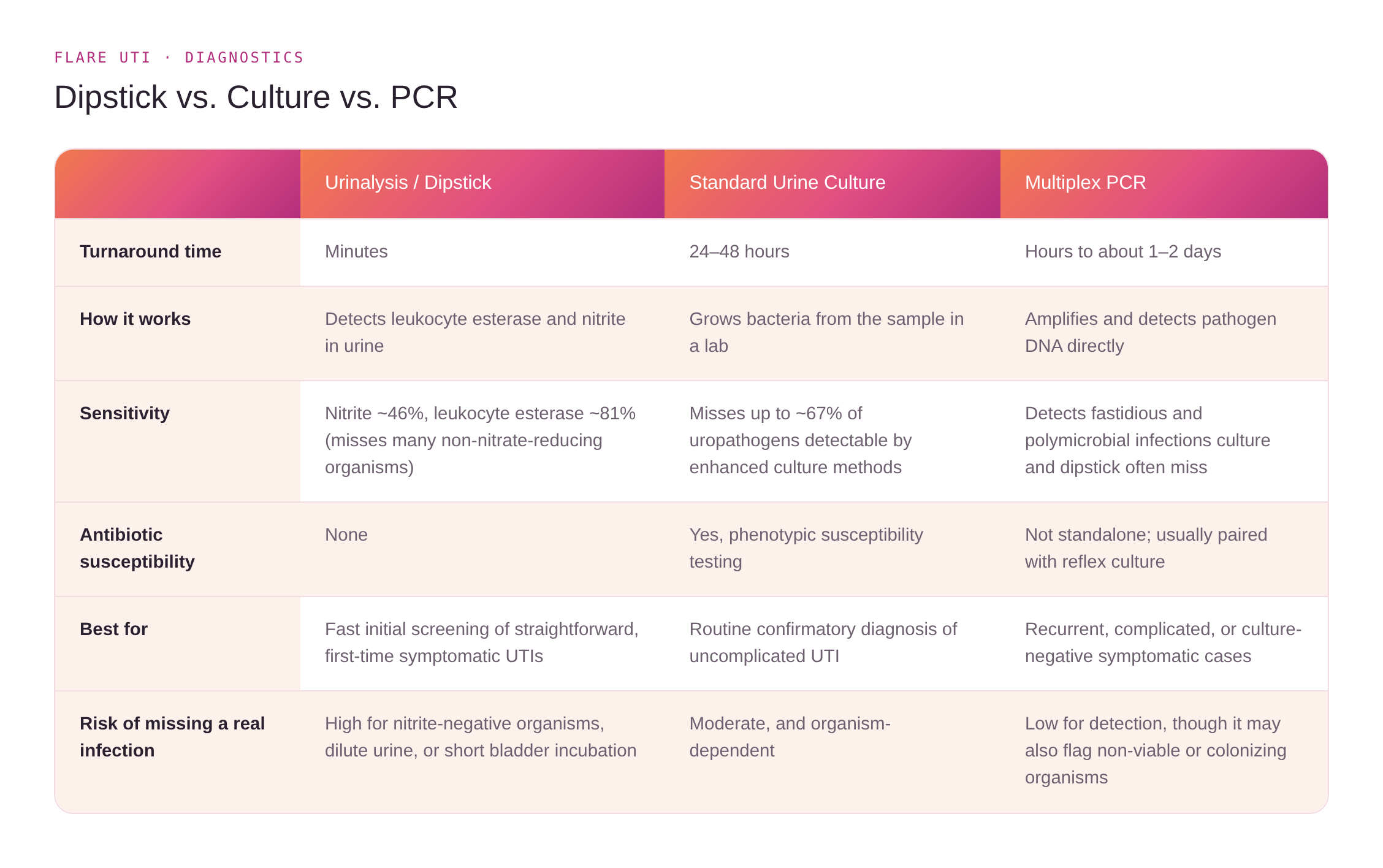
The in-office urine dipstick used for a fast answer tests for two things: leukocyte esterase (a marker of white blood cells) and nitrite (a byproduct some bacteria produce). Neither is as reliable as its speed suggests. A validity study of urine dipstick testing found leukocyte esterase has a sensitivity around 81% but a specificity of just 58%, while nitrite's sensitivity drops to about 46%, meaning a nitrite-negative result misses more than half of actual infections, particularly from organisms like Staphylococcus saprophyticus or Enterococcus that don't reliably convert nitrate to nitrite. The study's own conclusion: dipstick testing cannot reliably guide treatment on its own, and a negative result shouldn't be treated as ruling out infection in a symptomatic patient.
Standard urine culture, the next step up, isn't a perfect backstop either. A landmark 2016 study in the Journal of Clinical Microbiology found that standard culture missed roughly 67% of uropathogens detected by an enhanced culture protocol, and in women with severe urinary symptoms, standard culture caught only about a third of what the enhanced method found. It's one of the findings that helped overturn medicine's old assumption that urine is sterile, and it's part of why interest in alternative diagnostics, PCR included, has grown.
Put together, a patient with real, painful symptoms can go through dipstick testing, then culture, and still leave without an answer, not because nothing is wrong, but because the tools being used weren't built to catch it.
This pattern shows up constantly in practice: a walk-in dipstick reveals blood cells in the urine, a nonspecific sign that can point to infection, so the clinician starts a broad, empiric antibiotic without an organism ever being identified. The patient finishes the course, and the symptoms don't resolve. Once pelvic floor dysfunction, stress-related causes, and anatomical explanations have all been ruled out, what's often left standing is an infection the dipstick and standard culture simply didn't catch in the first place.
What PCR Does Differently
PCR (polymerase chain reaction) testing works differently from both of the above: it amplifies and detects pathogen DNA directly from the urine sample, without needing anything to grow or relying on a chemical byproduct. That means it can pick up fastidious, slow-growing organisms that culture misses (think Ureaplasma, Mycoplasma, Aerococcus urinae), flag polymicrobial infections more reliably, and often return results faster than culture's multi-day grow-out, all without depending on the metabolic quirks that make dipstick testing unreliable.
It's not a flawless replacement, though. PCR can detect DNA from nonviable or non-pathogenic organisms, results are typically reported in copies per microliter rather than the colony-forming-unit thresholds clinicians are used to from culture, and PCR alone doesn't provide phenotypic antibiotic susceptibility, which is why some platforms pair it with reflex culture.
Dipstick vs. Culture vs. PCR
Here's how the three approaches stack up side by side:
Where the Caution Comes In
This is worth saying plainly: professional guidance has not endorsed PCR as a routine replacement for urine culture, and for good reason. Current IDSA guidance on asymptomatic bacteriuria and on cystitis/pyelonephritis doesn't support reflexive molecular testing for straightforward UTIs, and a 2024 stewardship-focused review in Antimicrobial Stewardship & Healthcare Epidemiology concluded PCR "cannot replace" culture outright. The concern is real: PCR's sensitivity can pick up asymptomatic bacteriuria (present in as many as half of long-term-care residents) and treating a positive PCR result that reflects colonization rather than infection risks unnecessary antibiotic exposure. A newer PALTmed/AMDA consensus statement on urine PCR testing (2025) addresses this directly.
The takeaway isn't "don't use PCR": it's "use it selectively, in the patients where dipstick and culture have already let you down."
Where PCR Actually Earns Its Place
Based on current evidence and expert commentary, PCR tends to add the most value in a specific set of situations:
Recurrent or complicated UTIs, where repeated negative results haven't matched the patient's symptoms
Culture-negative, symptomatic patients, particularly where a fastidious organism is suspected
Suspected polymicrobial infections that a standard culture may oversimplify
Patients who'd already started antibiotics before a urine sample was collected, which can suppress culture growth but not DNA detection
Cases where faster time-to-appropriate-antibiotic matters: a 2024–2025 study in complicated UTI patients found PCR paired with pooled susceptibility testing shortened the time to the right antibiotic compared to culture alone
Outside of these situations, for a routine, first-presentation, symptomatic UTI, standard culture remains the appropriate first step.
Who's Doing This
A handful of labs have built out molecular UTI testing as a core offering. MicroGenDX runs a hybrid qPCR-plus-next-generation-sequencing platform (branded UroKEY) that screens against a database of more than 60,000 organisms, built specifically for the kind of complex, hard-to-pin-down infections where standard culture has already come up short. CirrusDx offers molecular testing alongside direct culture and antibiotic susceptibility testing from a single sample, aiming to close the gap between PCR's detection power and culture's actionable susceptibility data. Their materials don't explicitly brand the molecular component as PCR, so it's worth confirming their exact methodology directly if that distinction matters for your practice.
The Practical Takeaway
PCR testing isn't a wholesale upgrade from dipstick or culture: it's a different tool for a different job, best reserved for the recurrent, complicated, and diagnostically frustrating cases where the first-line tools haven't given a patient an answer. For physicians, the practical point isn't that PCR replaces dipstick or culture: it's that when a patient's pain doesn't match what those first-line tools are telling you, there's a next step worth considering before sending them home with no answer.
