
Every recurrent UTI patient leaves a paper trail. There's a culture here, a PCR panel there, three rounds of antibiotics, and a symptom history that lives mostly in the patient's memory and yours.
Somebody has to turn that pile into something you can read at a glance. Most practices handle it one of two ways. They pay someone to key it in by hand, or they don't, and the pattern stays buried in a stack of PDFs.
Both options cost money. One shows up on payroll. The other shows up in repeat visits, guesswork prescribing and patients who quietly go elsewhere.
The cost of entering it
If a recurrent UTI patient's history is going to be readable, someone has to read every lab report and type out the organism, the colony count, the resistance profile and the date. Then they do it again for the next result, and the one after that.
In most practices that someone is a medical assistant, or it's you.
When it's staff. The median medical assistant earns $45,690 a year (BLS, May 2025). That's before payroll taxes and benefits, which push the real cost toward $50,000. Every hour an MA spends transcribing PDFs is an hour they aren't rooming patients, returning calls or getting a nervous parent through a visit.
When it's you. Physicians already carry this weight. In one study of 142 family physicians, doctors spent 5.9 hours of an 11.4-hour day in the EHR, and 44% of that time went to clerical and administrative work. A national survey found physicians spent an average of 1.77 hours a day documenting outside office hours, and 58% said that time was not appropriate.
Either way, there are errors. Typing numbers off a PDF is tedious. Tedious work produces typos, skipped reports and inconsistent formats, and that's exactly the data you'll be relying on six months from now.
The cost of not entering it
The alternative is never entering the data at all. Many practices end up here by default. Results get filed, the chart gets a one-line note, and the patient's full history lives in a folder of PDFs and in your memory. That feels free, but it isn't.
You lose what the last culture already told you. A recurrent UTI patient comes back by definition: two or more infections in six months, or three in a year. IDSA guidance recommends using a prior culture to guide empiric treatment. A study of 232 recurrent UTI patients found that past susceptibility results helped predict future resistance to fluoroquinolones and ceftriaxone. In the same group, 38% of E. coli isolates were resistant to trimethoprim-sulfamethoxazole and 28% to ciprofloxacin. When the old results are three PDFs deep, the prescription becomes a guess.
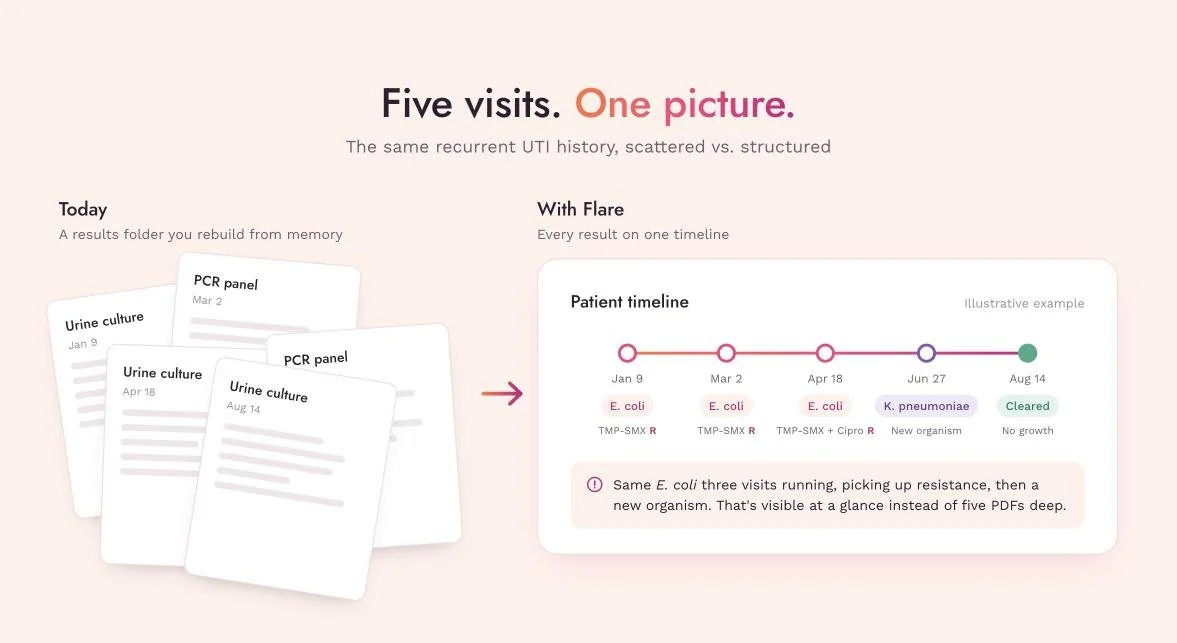
You can't tell cleared from new. Is this the same organism that never fully cleared, or a new one? Has its resistance changed? That's the question that decides the next step, and in pediatric patients especially, parents want an answer. It can't be answered from memory across five visits.
You pay for the workup again. A cost analysis in Urology put the acute workup for a recurrent UTI at $390 to $730, before antibiotics. Every cycle that ends without a clear pattern sets up the next one.
Patients notice. Recurrent UTI patients are often exhausted by the time they reach you. A patient who has to retell her history at every visit, or a parent who hears "let's try another round," starts looking for someone else. The patient whose cycle finally stops is the one who sends her friends your way.
A third option
The real choice isn't between paying someone to type and letting the data go. The work itself shouldn't need a person.
That's why we built Flare UTI with Dr. Ryan Heer, who sees more than 300 chronic UTI patients and needed this tool himself. Flare reads the lab reports you already receive, including detailed PCR panels, and turns them into a timeline for each patient: organisms, resistance, treatments and symptoms, side by side across every visit.
Patterns at a glance. You can see whether an organism keeps coming back, whether resistance is shifting, and what worked last time.
Doctor-only insights. Pattern analysis stays on the clinician side, where it belongs.
Built for compliance. Flare is HIPAA compliant, SOC 2 Type 2 audited and HITRUST e1 certified.
Research-ready. If you're interested in your own patient trends, the data is already organized.
The budget you'd spend on data entry can go toward someone who spends the day with patients. And you won't have to rebuild a patient's history from memory again.
Sources
Arndt BG et al. Annals of Family Medicine, 2017: EHR time among 142 family physicians. Summary via MDLinx
Gaffney A et al. "Medical Documentation Burden Among US Office-Based Physicians in 2019." JAMA Internal Medicine, 2022. PMC8961402
U.S. Bureau of Labor Statistics, OEWS May 2025, Medical Assistants (SOC 31-9092). Via WageDex
Valentine-King M et al. "Prior cultures predict subsequent susceptibility in patients with recurrent urinary tract infections." Antimicrobial Stewardship & Healthcare Epidemiology, 2022. DOAJ
Gaitonde S, Malik RD, Zimmern PE. "Financial Burden of Recurrent Urinary Tract Infections in Women." Urology, 2019. UT Southwestern
